

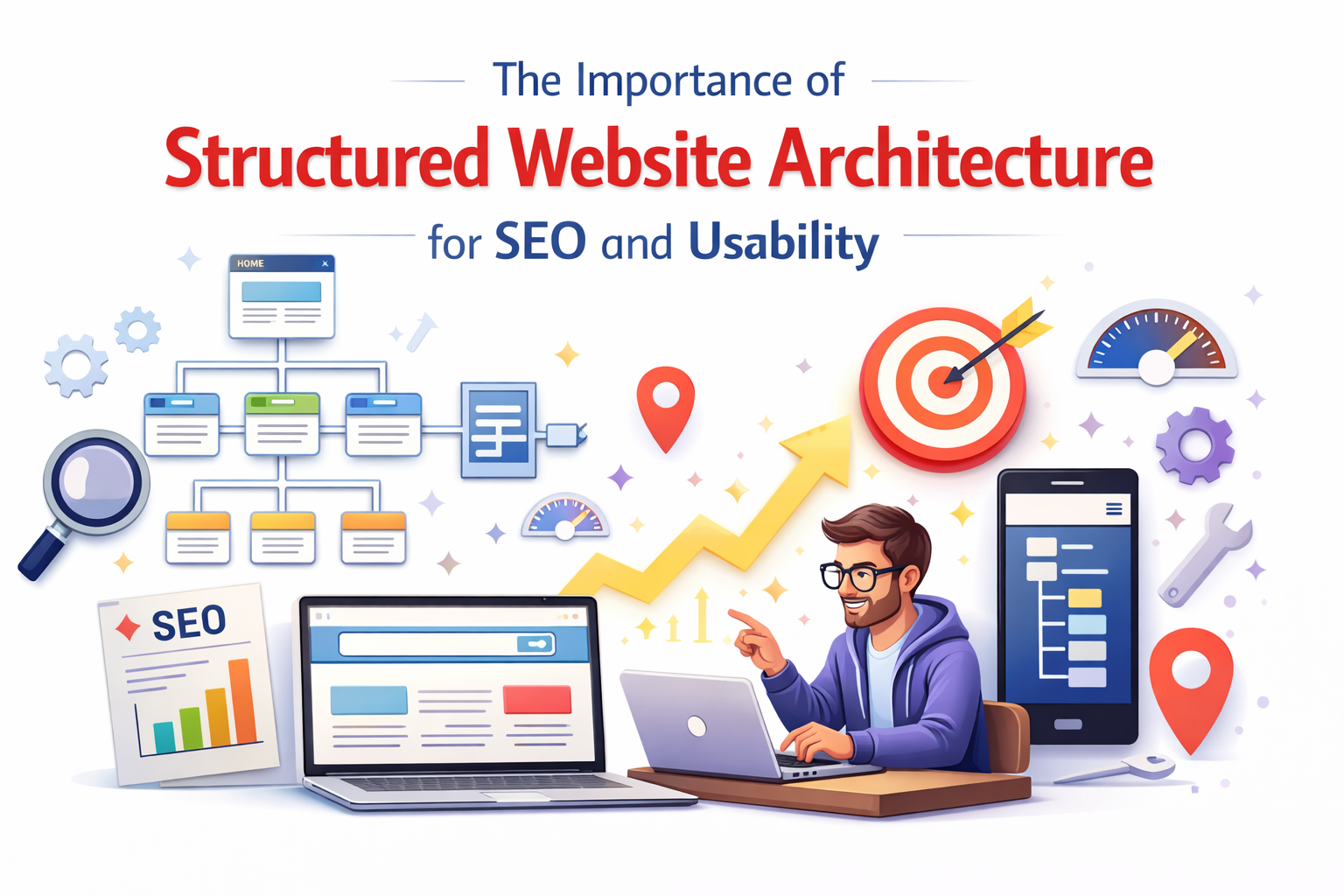
Building a new website that can be successful is a lot more challenging than it seems. Consider it building like a large house or tall tower, with so many resources, investment, and maintenance. You can’t just throw the bricks and wood and hope for the best results.
With website designing and development, you need a solid plan, a deep foundation, and a clear layout. In the digital ecosystem, the layout is known as website architecture. It simplifies the way to organize pages and connect through links and menus.
A properly structured website helps both search engine bots and visitors. The website is easy to browse, and people are likely to stay longer and buy more. In this blog, let’s explore the importance of structured website architecture in 2026. Keep reading till the end to understand its role for a successful online presence.
What is Website Architecture?
Website architecture is all about the hierarchical structure of the pages. It includes the menus, internal linking, and URL structures. Consider it like a digital map that shows the visitor how to browse the pages. It makes the website journey smooth so anyone can easily find what they’re expecting without getting confused.
The majority of the website suggests a flat architecture that allows anyone to search any page within four clicks. If your content remains too deep on the website, it can be invisible to the world. The more detailed the website architecture, the harder it will be for search engines to find the new content.
Why Website Structure Matters for SEO
Various search engines like Google have “crawlers” or “spiders” to understand websites and discover new content. If your website structure is a mess, the spiders might get stuck and miss important pages. As a result, these failures can also lead to a higher ranking on the search engines.
a) Efficient Crawling and Indexing
Google has a “crawl budget” phenomenon that highlights the time and resources spent on a website’s single visit. If your website has a structured hierarchy, the spider can quickly move from the home page to categories and individual pages.
A clean and organized website structure ensures that the most important pages get indexed. Further, this also helps in achieving a higher ranking in the search engines for targeted keywords and search phrases.
b) Distribution of Link Authority
Your website’s home page is important for users. Similarly, it holds more value because most external links to it first. Because of the internal linking, you can help other pages rank well under categories and individual pages.
A website structure planning guide ensures that the “link juice” moves to priority pages and blogs. In short, the proper distribution of the link authority helps in ranking other website pages as well.
c) Sitelinks in Search Results
Have you ever faced a situation where sub-links come after searching for a brand on Google? These are known as sitelinks and are only possible for websites with good architecture. There is no way you can force Google to offer sitelinks for your website.
With sitelinks, your website and brand may seem more professional to the end users. Further, these sitelinks take up more space on the screen and enhance engagement levels.
Improving the User Experience (Usability)
Website SEO brings more people to the website. But, post that, it’s the website usability and experience that really matter for businesses. It’s as simple as users leaving the website if they didn’t find what they’re looking for. This is known as bouncing, and bounce rate tells Google that your site is not helpful to the users.
a) Reducing Cognitive Load
When it comes to checking websites, users tend to scan them rather than reading every single word. A clear and easy website menu simplifies browsing the website. For example, if you own an online clothing website, it should have categories like “Men,” “Women,” and “Accessories”.
These are so easy to understand for both users and search engines. In case you end up hiding these under “Our Collection,” it will make the users confused and leave.
b) Creating a Logical Journey
A good website structure will lead the user toward the end goal of conversions. No matter if you want them to buy the product, sign up for a newsletter, or get a quote, the path should be obvious.
The little links at the top of the website page (known as Breadcrumbs) can be a great tool. These guide the users in their exact position and allow them to jump back to the main category with a single click.
c) Mobile Friendliness and Speed
When it comes to designing the website hierarchy or structure, considering mobile users is a priority. The website should look, open, and feel amazing on small-screen devices, too.
A well-organized website menu looks easy on mobile screens and allows users to click easily. It saves the user from lengthy scrolling just to find the contact link. Additionally, a good website structure makes the website load faster on all devices.
How to Build a Great Website Structure In 2026
Thinking of a website launch is one thing, and planning for it is another. You should start with a plan that can lead to long-term success. The first step should be to find the right domain, hosting, and website template. It will ensure that you can create a map sketch related to the high-level overview of the website. There will be plenty of design tools to create the website sketch with ease.
a) Use a Top-Down Approach
To design the perfect website architecture, start with the home page and go to the bottom. The hierarchy should have a a top-level page with 3 to 5 categories below it.
Under these categories, there need to be individual sub-pages or products. This strategy keeps the website structure near and clean for everyone.
b) Keep URLs Simple and Descriptive
Your page URLs should be self-explanatory for both users and search engine bots. Rather than just a combination of some numbers and strings, these need to be service or offering-focused. The best thing is that the user should be able to understand what the page is all about from the URL.
c) Smart Internal Linking
Every website page should have links pointing inside and outside to the website. This safeguards the page from becoming an orphan that no one can easily find. Your website linking structure tells the story of your content relating to the other topics.
Hire Toyavi Technology For Launching A Successful Website In 2026!
Are you ready to transform your offline business to the online world? At Toyavi Technology, the best IT company in India, we specialize in designing and launching the best websites. Our website solutions are high-quality and look better and perform exceptionally. We focus on creating the best website architecture that helps search engines and users understand better.
Gone are the days when you had to launch a confusing or messy website in 2026. Now, you can have the most creative website that can serve to its full potential. No matter if you’re launching a new website or performing an SEO audit of the existing one, we’re there for you. At Toyavi Technology, we convert your digital strategy into a powerful growth engine for your brand.
Reach out to us today and get a consultation for launching a structured and user-friendly website that drives results.